Introduction: A Defining Moment for Kenya’s Development Sector
Kenya’s Public Benefit Organizations (PBO) sector is undergoing one of its most transformative periods in decades. The PBO Sector Report 2024/2025 not only highlights impressive growth but also reveals critical structural challenges that could shape the future of development in the country.
With the operationalisation of the PBO Act in May 2024, the sector has shifted from a fragmented NGO framework to a more unified and regulated ecosystem. This transition marks a new era of accountability, transparency, and strategic alignment with national priorities—but it also exposes deep-rooted vulnerabilities.
Rapid Growth Signals a Thriving—but Uneven Sector
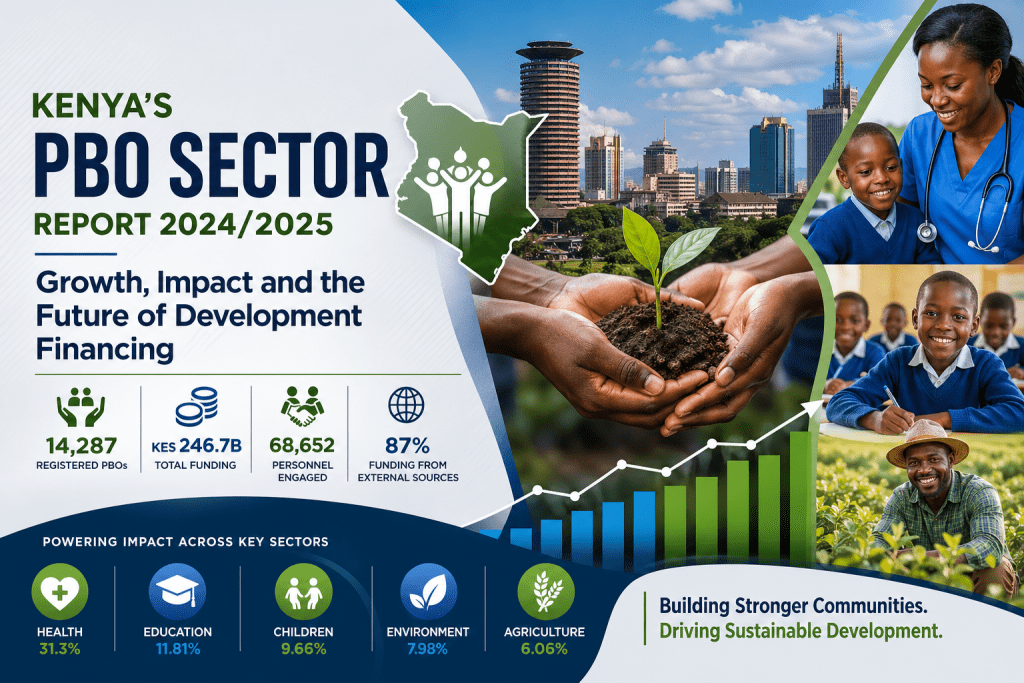
The numbers tell a compelling story. Kenya now has over 14,287 registered PBOs, with 9,609 actively operational. In just one year, 685 new organizations joined the sector, demonstrating strong momentum and continued relevance in addressing societal needs.
However, beneath this growth lies a critical concern: only a fraction of these organizations are fully compliant with reporting requirements. Less than a quarter submitted annual reports during the review period, revealing a significant compliance gap.
This suggests the existence of a two-tier sector:
- A formal, compliant group that engages with donors and regulators
- A larger, less visible segment operating with limited oversight
For policymakers and stakeholders, this presents both an opportunity and a risk—growth without full accountability may undermine long-term credibility.
A Major Economic Force in National Development
The PBO sector has firmly established itself as a key economic player in Kenya’s development landscape. In the 2024/2025 financial year, the sector mobilized KES 246.7 billion, with over KES 156 billion invested in development projects.
Notably, 86.6% of project funding was spent within Kenya, reinforcing the sector’s role in local development and service delivery.
From healthcare and education to environmental conservation and agriculture, PBOs continue to complement government efforts—often stepping in where public systems face capacity constraints.
This positions the sector as more than just a support system; it is increasingly becoming Kenya’s silent development infrastructure.
Sector Priorities Reflect National Needs—and Gaps
An analysis of funding allocation reveals where the country’s most pressing needs lie. The largest share of funding was directed toward:
- Health (31.3%)
- Education (11.81%)
- Children-focused programs (9.66%)
- Environment (7.98%)
These priorities mirror ongoing national challenges, particularly in healthcare access, education equity, and climate resilience.
However, the report also highlights concerning declines in key areas:
- Relief and disaster management funding dropped significantly
- Investment in research and innovation declined sharply
- Energy sector funding saw a dramatic reduction
This trend suggests a shift toward short-term service delivery at the expense of long-term resilience and innovation—raising questions about the sector’s strategic direction.
Foreign Funding Dominance Raises Sustainability Concerns
One of the most critical insights from the report is the sector’s overwhelming reliance on foreign funding. Approximately 87% of total funding originates from external sources, primarily from North America and Europe.
Locally generated funds account for only a small fraction of total inflows.
While international support has been instrumental in sustaining development efforts, this dependency exposes the sector to external shocks, including:
- Changes in global donor priorities
- Economic downturns in donor countries
- Geopolitical shifts
Without stronger local financing mechanisms, the sector risks long-term vulnerability.
Employment and Youth Engagement: A Hidden Strength
Beyond funding and projects, the PBO sector plays a significant role in job creation and skills development. In the past year alone, it engaged over 68,000 personnel, with 98% being Kenyan nationals.
Additionally, more than 28,000 volunteers and interns were involved, highlighting the sector’s importance as a platform for youth engagement and professional development.
In a country grappling with youth unemployment, the PBO sector emerges as a critical labour market stabiliser.
Geographic Distribution Points to Unequal Development
While PBOs operate across the country, their presence is heavily concentrated in urban and peri-urban areas such as Nairobi, Kisumu, and Kajiado.
This concentration raises concerns about equitable access to development interventions, particularly in remote and marginalized regions.
For the sector to achieve inclusive impact, there is a need to decentralize operations and expand reach into underserved communities.
Collaboration is Strong—but Needs Depth
The report highlights a high level of collaboration among PBOs, government agencies, and other stakeholders. However, most of these partnerships are centered around information sharing rather than deep, impact-driven collaboration.
To maximize impact, the sector must move toward:
- Joint programme design
- Shared funding models
- Integrated development strategies
Stronger, more strategic partnerships could unlock greater efficiency and sustainability.
Regulation and Technology: The Future of the Sector
With the introduction of the PBO Act and emerging regulatory frameworks, the sector is entering a new phase of governance. There is a growing emphasis on:
- Risk-based oversight
- Anti-money laundering compliance
- Use of digital systems and emerging technologies
The integration of Artificial Intelligence (AI) and automation in regulatory processes signals a future where data-driven decision-making will define sector performance.
Organizations that adapt to this shift will be better positioned to thrive.
Conclusion: A Sector Full of Promise, Facing Critical Choices
The PBO sector in Kenya stands at a strategic crossroads.
On one hand, it is:
- Expanding rapidly
- Driving economic and social impact
- Supporting national development priorities
On the other hand, it faces significant challenges:
- Heavy reliance on foreign funding
- Low compliance levels
- Uneven distribution of impact
- Declining investment in long-term sectors
The path forward will require deliberate action:
- Strengthening local resource mobilization
- Enhancing compliance and accountability
- Investing in innovation and sustainability
- Deepening partnerships across sectors
Ultimately, the future of Kenya’s development ecosystem will depend on how effectively the PBO sector evolves from a donor-driven model to a resilient, locally anchored system.