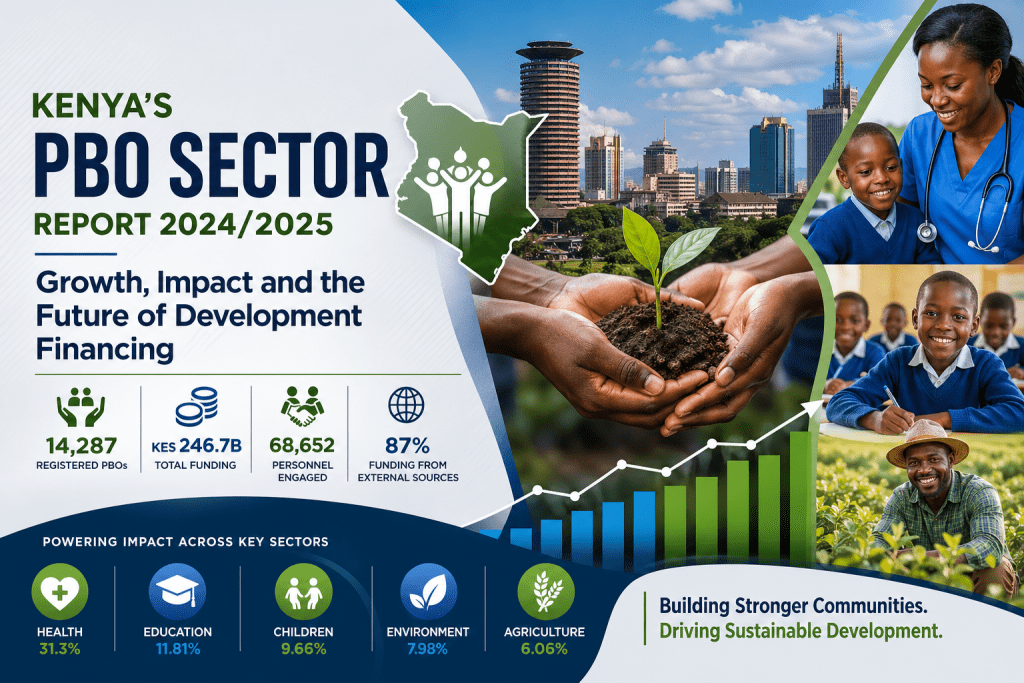
Nairobi, April 2026 — Non-governmental sector in Kenya is staring at one of its most consequential transitions in decades following the formal gazettement and launch of the Public Benefit Organizations (PBO) Regulations, 2026, a move that signals tighter oversight, expanded operational scope, and a decisive shift in how civil society operates.
The regulations, unveiled on March 18, 2026, mark the full operationalisation of the PBO Act, effectively replacing the long-standing NGO Coordination framework. The transition ushers in what sector players are describing as a “new face” of NGOs—one grounded in transparency, accountability, and sustainability.
At the centre of the reforms is a fast-approaching compliance deadline of May 13, 2026, by which all existing NGOs must transition into the new PBO framework. Organizations that fail to submit the required documentation to the Public Benefit Organizations Regulatory Authority (PBORA) risk losing their legal status within 30 days of receiving a default notice.
The directive has triggered a flurry of activity across the sector, with organizations racing to align their governance structures, financial reporting systems, and operational mandates with the new legal requirements.
Tightening the Net
Government officials have framed the reforms as necessary to restore credibility and order within a sector that has, in recent years, faced growing scrutiny over accountability gaps and the proliferation of dormant or non-compliant entities.
In a sweeping compliance drive, authorities have already deregistered approximately 4,779 NGOs, signaling a zero-tolerance stance on what has often been referred to as “briefcase organizations.”
The new framework introduces stricter reporting obligations, including mandatory annual reports and detailed asset inventories—measures aimed at enhancing transparency and enabling better oversight of donor funds and locally generated resources.
A Shift Toward Sustainability
Beyond regulation, the PBO Act is also redefining the financial architecture of the sector. In a notable departure from previous restrictions, organizations are now permitted to engage in lawful economic activities to support their public benefit objectives.
This provision is expected to ease longstanding concerns over donor dependency, particularly at a time when global funding flows to developing countries are becoming increasingly unpredictable.
Development experts argue that the shift could catalyse a new generation of hybrid NGOs—entities that combine social impact with income-generating models to sustain their operations.
“This is not just a compliance exercise; it is a structural transformation of the sector,” said a Nairobi-based governance analyst familiar with the reforms. “Organizations must now think beyond grants and begin to institutionalize sustainability within their core strategies.”
Opportunities and Uncertainty
While the reforms have been largely welcomed as a step toward professionalizing the sector, they have also raised concerns among smaller organizations that may lack the capacity to meet the stringent requirements within the given timelines.
Sector insiders warn that without adequate support and awareness, some grassroots organizations risk exclusion, potentially shrinking the diversity of voices within Kenya’s civil society space.
At the same time, the emphasis on partnerships embedded in the PBO framework is expected to strengthen collaboration between government, private sector actors, and civil society—an approach aligned with Kenya’s broader development agenda.
Race Against Time
With less than a month to the compliance deadline, the coming weeks are expected to be critical. Legal experts and sector bodies are urging organizations to expedite their transition processes, warning that delays could have far-reaching consequences, including loss of operational legitimacy and access to funding.
For many NGOs, the moment represents both a challenge and an opportunity—a chance to reset, rebuild trust, and reposition themselves within an evolving development landscape.
As Kenya’s civil society sector turns this regulatory corner, one thing is clear: the era of loosely regulated operations is drawing to a close, giving way to a more structured, accountable, and potentially resilient ecosystem.
This story is prepared in the voice of Savvyscope Media Solutions, providing strategic communication insights on emerging developments within NGO and development sector in Kenya.